TREATMENT OPTIONS
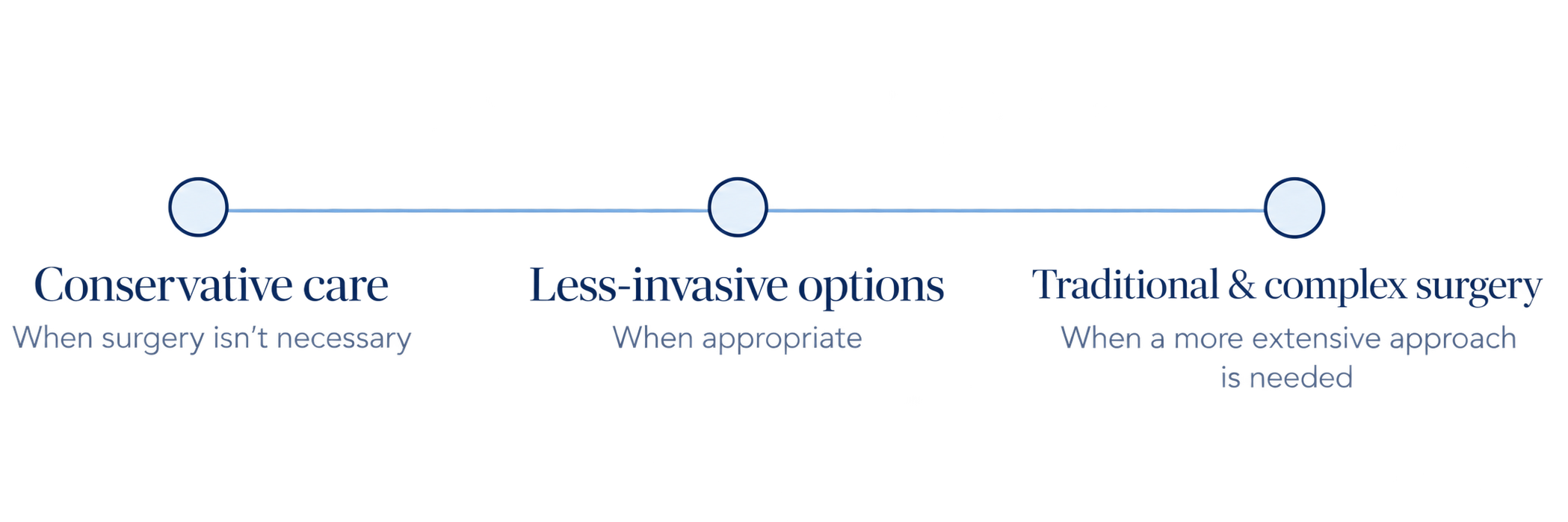
And when surgery is appropriate, there’s more than one way to approach it. Dr. Perrone considers the whole picture — your symptoms, exam, imaging, previous treatments and goals — before recommending a path forward.
The right treatment isn’t always surgery.
NON-SURGICAL TREATMENTS
Not every spine problem needs an operation.
Depending on the condition and symptoms, treatment may begin with options such as physical therapy, medications, injections, activity modification or simply giving the problem time.
If non-surgical treatment is appropriate, Dr. Perrone can help patients understand what to try next and when it may be worth reconsidering the plan.
ENDOSCOPIC SPINE SURGERY
A smaller approach to certain spine problems.
For appropriately selected patients, endoscopic spine surgery allows the surgeon to access certain areas of the spine through a small incision using a camera and specialized instruments.
But smaller doesn't automatically mean better.
The question isn't simply whether a procedure can be done endoscopically. It's whether an endoscopic approach appropriately addresses the problem.
MINIMALLY INVASIVE SPINE SURGERY
Less disruption when the right operation allows for it.
Certain spine procedures can be performed using smaller approaches designed to limit disruption to surrounding tissues.But smaller doesn't automatically mean better.
Minimally invasive techniques are tools — not a treatment philosophy on their own. The goal is to use the least disruptive approach that still appropriately treats the underlying problem.
TRADITIONAL & COMPLEX SPINE SURGERY
Some spine conditions require a more traditional or complex operation to adequately address the problem.
Dr. Perrone's training spans minimally invasive techniques through complex spine surgery, allowing the surgical approach to be selected based on the problem rather than a preference for one particular technique.
How do we decide?
Your MRI doesn't make the decision by itself.
Together, these pieces help shape the treatment plan.
Symptoms
What you're actually experiencing
Exam
What the physical examination shows
Imaging
What the MRI/X-rays show

History
What you've already tried

Goals
What you want to get back to doing