Endoscopic Spine Surgery
A less-invasive approach to certain spine problems.
Endoscopic spine surgery is a minimally invasive technique that allows a spine surgeon to treat certain conditions through a small incision using a camera, called an endoscope, and specialized surgical instruments.
Dr. Gabriel Perrone is a fellowship-trained orthopedic spine surgeon serving patients in Newton and the Greater Boston area, with specialized training in endoscopic and minimally invasive spine surgery.
For appropriately selected patients, an endoscopic approach may allow certain causes of nerve compression to be treated while limiting disruption to surrounding tissues.
But the important question isn't simply whether a procedure can be done endoscopically.
It's whether endoscopic spine surgery is the right way to treat your particular problem.
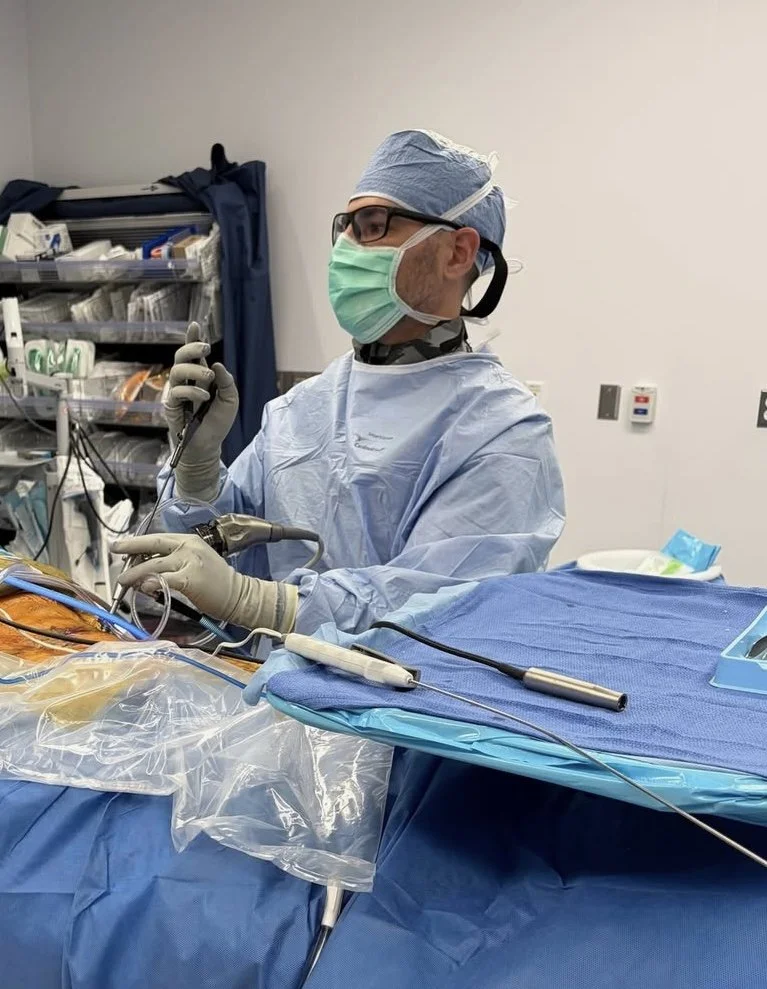
WHAT IS ENDOSCOPIC SPINE SURGERY?
Spine surgery through a different approach.
Endoscopic spine surgery is a type of minimally invasive spine surgery that uses a small camera to give the surgeon a direct view of the area being treated.
The endoscope and specialized surgical instruments are introduced through a small working channel. This allows the surgeon to reach certain areas of the spine and address specific causes of nerve compression through a relatively small incision.
Depending on the condition, endoscopic techniques may be used to remove a portion of a herniated disc, create more room around a compressed spinal nerve, or address certain other sources of nerve compression.
These procedures are sometimes referred to as endoscopic discectomy or endoscopic decompression, depending on what is being treated.
There are several different endoscopic approaches, and the appropriate technique depends on the location of the problem, the patient's anatomy, symptoms and imaging.
POTENTIAL BENEFITS
What are the potential benefits of endoscopic spine surgery?
For the right patient and the right condition, an endoscopic approach may offer potential advantages compared with a more traditional surgical exposure.
Smaller incision
Endoscopic spine surgery uses a small working channel to reach the area being treated.
Less disruption to surrounding tissue
Certain procedures can be performed while limiting disruption to the muscles and other structures surrounding the spine.
Outpatient surgery in many cases
Some endoscopic spine procedures may be performed on an outpatient basis without an overnight hospital stay.
Potential for a quicker early recovery
For certain patients and procedures, a less-invasive approach may allow an earlier return to normal activities.
Individual results and recovery vary. The potential benefits of endoscopic surgery depend on the specific condition, procedure and individual patient.
CONDITIONS TREATED
What conditions can endoscopic spine surgery treat?
Endoscopic techniques may be considered for certain spine conditions that cause compression or irritation of a spinal nerve.
They are particularly useful for selected problems involving the lumbar spine, or lower back.
Depending on the individual patient, endoscopic spine surgery may be considered for certain cases of:
Lumbar Disc Herniation
A herniated disc occurs when disc material extends beyond its normal position and irritates or compresses a nearby spinal nerve.
This can cause lower back pain as well as pain, numbness, tingling or weakness that travels into the buttock or leg.
In selected patients, an endoscopic discectomy may be used to remove the portion of disc that is compressing the nerve.
Lumbar Radiculopathy and Sciatica
Lumbar radiculopathy occurs when a nerve in the lower back becomes irritated or compressed.
Patients may experience pain, numbness, tingling or weakness extending from the lower back or buttock into the thigh, calf or foot. These symptoms are often referred to as sciatica.
When symptoms are caused by a problem that can be appropriately addressed through an endoscopic approach, endoscopic surgery may be one treatment option.
Lumbar Spinal Stenosis
Lumbar spinal stenosis is narrowing around the nerves in the lower back.
It can cause pain, numbness, weakness or heaviness in the legs, particularly while standing or walking. Some patients notice that symptoms improve when they sit down or lean forward.
Certain patterns of spinal stenosis and nerve compression may be treated with an endoscopic decompression. Other forms of stenosis may require a different surgical approach.
Recurrent or Persistent Symptoms After Spine Surgery
New or persistent leg symptoms after previous lumbar spine surgery deserve careful evaluation.
In selected situations, an endoscopic approach may be considered when symptoms can be traced to a specific area of recurrent or persistent nerve compression.
Having one of these conditions does not necessarily mean you need surgery — or that endoscopic surgery is the right operation.
CANDIDACY
Am I a candidate for endoscopic spine surgery?
Determining whether someone is a candidate for endoscopic spine surgery requires more than looking at an MRI.
Dr. Perrone considers the entire clinical picture:
Your symptoms
Where you're experiencing pain, numbness or weakness and how those symptoms affect your daily life.
Your physical examination
Whether the examination points toward a particular spinal nerve or area of the spine.
Your imaging
Whether an MRI, X-rays or other imaging identifies a problem that corresponds with your symptoms.
Previous treatment
What you've already tried, including physical therapy, medications, injections or previous spine surgery.
Your goals
What you want to get back to doing and what matters to you when considering treatment.
Some patients may be better served by continued non-surgical treatment. Others may benefit from endoscopic or another minimally invasive procedure. Certain spine problems are better treated with a more traditional surgical approach.
The goal is to match the treatment to the problem — not simply to perform the smallest procedure possible.
FREQUENTLY ASKED QUESTIONS
Common questions about endoscopic spine surgery
How big is the incision for endoscopic spine surgery?
Endoscopic procedures are performed through a small incision and working channel. The exact incision and approach depend on the procedure being performed.
Is endoscopic spine surgery outpatient?
Many endoscopic spine procedures may be performed on an outpatient basis, but this depends on the specific procedure, the patient's health and other individual factors.
How long is recovery after endoscopic spine surgery?
Recovery varies depending on the condition, procedure and individual patient. A less-invasive approach may allow for a quicker early recovery in some appropriately selected patients, but there is no single recovery timeline that applies to everyone.
Can a herniated disc be treated with endoscopic surgery?
Certain lumbar disc herniations can be treated with an endoscopic discectomy. Whether this is appropriate depends on the location and type of disc herniation, the patient's symptoms, anatomy and other factors.
Can spinal stenosis be treated endoscopically?
Certain types of lumbar spinal stenosis and nerve compression may be treated with endoscopic decompression. More extensive or complex patterns of stenosis may require a different approach.
Can endoscopic spine surgery treat sciatica?
Sciatica is a term commonly used for pain that travels along the path of a nerve into the leg. When sciatica is caused by a specific area of nerve compression that can be treated endoscopically, an endoscopic procedure may be an option.
Is endoscopic spine surgery better than traditional spine surgery?
Neither approach is better for every patient or every condition. The appropriate approach is the one that adequately addresses the underlying problem while taking the patient's individual circumstances and goals into account.
What if I'm not a candidate for endoscopic spine surgery?
Dr. Perrone's practice isn't limited to endoscopic procedures. Depending on your condition, treatment options may include continued non-surgical care, another minimally invasive technique or a more traditional spine operation.